Why 2026 is the year Web2 founders are looking at tokens
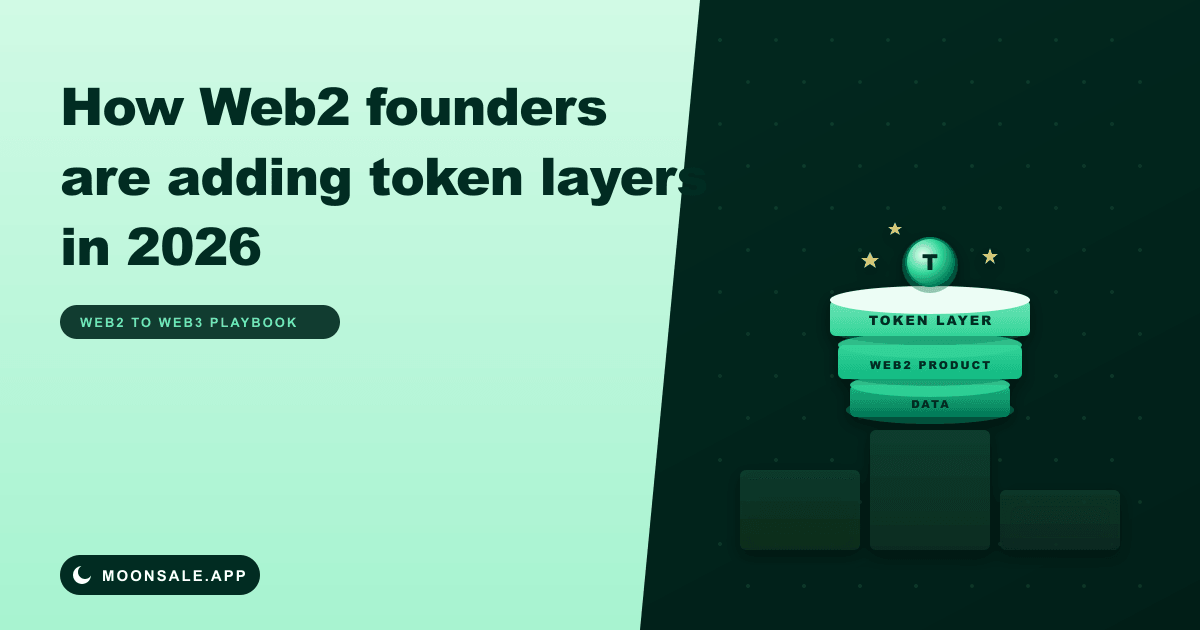
For most of the last cycle, "Web2 plus token" meant either a points-and-rewards experiment that quietly died (Reddit Moons, several creator-coin attempts) or a security-token offering that got buried in legal review. The pattern in 2026 is different. Web2 SaaS, marketplaces, fitness apps, creator platforms, and consumer products with real users are now adding token layers as growth and retention infrastructure, not as a separate fundraising bet.
Three forces converged to make this possible. First, regulatory frameworks in the EU (MiCA), UK (FSMA crypto regime), Singapore, and parts of the US clarified utility-token versus security-token treatment well enough that founders can ship something without betting the company on an SEC interpretation. Second, the operational tooling matured: contract templates are audited, liquidity locks are standard, and platforms like MoonSale handle the deploy-and-list flow without requiring a Solidity team. Third, post-2024 consumer attention shifted: users of any product with a points or rewards layer now ask why those points are not portable, transferable, or backed by something liquid.
If you are a Web2 founder reading this, the question is not whether tokens are an option. The question is whether your specific product benefits from one, what the right pattern looks like, and how to ship it without breaking your existing business.

The four token-layer patterns Web2 products are adopting
Across the Web2 founders we have worked with on MoonSale, four patterns account for almost all live deployments. Pick the one that matches your product; mixing two of them in the same launch usually slows you down.
Pattern 1: Loyalty and rewards tokenization
The Web2 version: users earn points for activity (purchases, posts, referrals, streaks). Points sit in a private database, expire after 12 months, and cannot be moved between users.
The token-layer upgrade: points become an ERC-20 (or BEP-20) with a fixed or capped supply. Users earn the same way, but the token is transferable, tradeable on a DEX, and visible in any wallet. The product team controls minting through an authorized minter contract.
This is the most common pattern in 2026 because it is the smallest behavior change for existing users. They keep earning the same way; they just get a balance that is theirs, not the product's. Marketplaces, fitness apps, learning platforms, and content sites have all shipped this version. The token usually launches via a fair launch (no fundraising, fair distribution to existing users plus new buyers) so it does not look like an ICO.
Pattern 2: Marketplace fee rebates and creator economy
The Web2 version: a marketplace charges a 10 to 30 percent fee. Creators or sellers absorb the fee. Buyers see no benefit from being loyal to the platform versus a competitor.
The token-layer upgrade: a portion of platform fees buys back the token from the open market and either burns it or distributes it as rebates to active users. Creators see a measurable benefit from being on the platform; buyers see one too. The token is governance-light or pure utility (rebate currency).
This pattern requires real revenue from day one because the buyback or rebate is funded from fees. Pre-revenue products should not ship this; the buyback math does not work. For a marketplace doing $200k+ per month in GMV, a 5 to 10 percent fee directed to buyback is enough to support a meaningful token.
Pattern 3: Referral and network effects
The Web2 version: refer-a-friend gives a one-time discount. Most users never refer because the friction is high and the reward is small.
The token-layer upgrade: referrals mint tokens to both parties on a vesting schedule. The token has utility inside the product (discount, gated features, governance over a small treasury) and tradeable value outside it. Long-time referrers accumulate a balance that compounds; the network effect becomes financially measurable.
This pattern works best for products with viral mechanics already built in (consumer social, multiplayer games, creator tools). It does not work for B2B SaaS where the buyer is not the user. The token launch typically uses a presale to bootstrap initial liquidity, then opens to organic referral mints. The launch model decision is covered in Presale vs Fair Launch: Which One Is Right for Your Token?.
Pattern 4: Revenue share and treasury participation
The Web2 version: investors get equity. Users get nothing beyond the product itself.
The token-layer upgrade: a token represents a claim on a treasury that holds protocol-owned liquidity, fee revenue, or product cash flow. The token is closer to a security than a utility token in most jurisdictions, so it usually launches under a regulated framework (MiCA-compliant ART, regulated security token, or jurisdictional carve-out for tokenized revenue share).
This pattern is the most powerful and the most legally complex. It is the right answer for products with consistent revenue and a community of power users who would invest if given the chance. It is the wrong answer for early-stage Web2 products that do not have predictable revenue. If you are not sure whether your token is a utility or a security, assume security and talk to a crypto-native lawyer before committing to this pattern.
When adding a token layer actually makes sense
The four-question filter we walk founders through before they commit to a token launch:
1. Do you have a real Web2 product with non-trivial users right now? If your product has fewer than a few thousand active users, ship more product first. A token layer accelerates an existing flywheel; it does not create one.
2. Is your product's value capture currently broken? Specifically: do users contribute value (content, referrals, network effects, GMV) without seeing any of it back? If yes, a token layer can fix the asymmetry. If your business already pays out a fair share through revenue share, creator payouts, or affiliate commissions, you may not need a token.
3. Is there an obvious utility for the token inside your product? Discount, governance over feature priority, gated access, fee rebate, staking for higher tier. At least one of these has to be real. If the token is purely speculative ("hold for upside"), retention will be terrible after the launch hype fades.
4. Are you prepared to operate as a token issuer for at least 24 months? That means quarterly token-economy reports, on-chain treasury management, community governance touchpoints, and a real chunk of your time spent on token holders alongside product users. If you cannot commit to this, ship product without a token.
If you answer yes to all four, a token layer is probably worth the work. If you answer yes to three of four, it is borderline; talk to two other founders who have launched tokens before deciding. If you answer yes to two or fewer, do not ship a token yet.

When it does not (and you should not ship one)
Anti-patterns we see consistently:
Pre-revenue Web2 products treating a token as a fundraising shortcut. The token raise is not the same as a seed round. Token holders expect liquidity, governance, and ongoing communication. Equity investors expect a board seat and financial reporting. Treating the two interchangeably will burn one of them.
Products with fewer than a few thousand active users. A token launch with 200 holders cannot sustain a market. The post-launch chart is flat or down. The team spends the next year explaining why. Ship more product first.
Products where the token has no inside-product utility. "Hold for governance over a 50k treasury" is not utility. Real utility is "use this token for fee rebates" or "stake to access tier 2 features" or "vote on next month's feature priorities with weighted votes."
Founders who view the token launch as an exit. This pattern is obvious to the community within a quarter. Sell pressure increases. The chart goes one direction. The full breakdown of launch-day mistakes that signal this is in Launching a Token: Common Mistakes.
Products in regulated industries without specific legal counsel. Healthcare, financial services, gambling-adjacent, real estate. The default assumption is that the token is a security; getting it wrong here is expensive in a way that founders cannot afford.
How Web2 teams are launching: presale, fair launch, or airdrop
Three legitimate options for Web2 founders, each suited to a different starting point.
Fair launch is the default for most Web2 to Web3 layer-additions. The token starts trading at a community-priced rate; existing users get a guaranteed allocation; new buyers participate on equal terms. There is no "founder team got tokens at $0.001 and dumps on retail" risk. Fair launches are the right call when the Web2 product already has scale and you are tokenizing existing usage. Run it through Create Fair Launch on MoonSale.
Presale makes sense when you need to raise capital alongside the launch (treasury for buybacks, liquidity provisioning, future development) and you have a clear use of funds. Presale rates are fixed; listing rate must be higher than presale rate (the platform enforces this on chain). Presales work best when there is genuine demand from your existing audience, not just speculative demand from launchpad regulars. Use Create Presale for the standard fixed-price flow.
Airdrop to existing users plus a smaller listing event is the third pattern. Existing Web2 users get tokens proportional to their historical contribution (purchases, posts, referrals); the rest of the supply lists on a DEX through a small initial liquidity pool. This is the "thank-you-to-the-community" launch. It works best for products with a clear usage history and a community that already feels ownership of the brand.
The full pre-launch community-building sequence is in How to Build Community Before Launch.
The legal reality in 2026
The honest version: jurisdiction matters more than your token mechanics.
In the EU under MiCA, utility tokens have a relatively clear path: white paper notification, no prospectus, no banking-level reserve requirements as long as the token is not an asset-referenced token (ART) or e-money token (EMT). Most Web2-to-token launches fit utility-token treatment.
In the UK under FSMA crypto provisions (effective 2025-2026), a similar regime applies, with the FCA requiring approval for promotions targeted at UK consumers. Plan for a 4 to 8 week registration window if your launch will be marketed to UK users.
In the US, the regulatory situation in 2026 is clearer than 2024 but still depends on whether your token has profit-sharing or governance over revenue (security indicators) versus pure utility. Most Web2 founders launching from the US either geo-block US persons at the launch event, structure as a foundation in a friendlier jurisdiction (Cayman, BVI, Liechtenstein), or operate the token issuance through a non-US entity.
In Singapore, the MAS Payment Services Act covers utility tokens with fewer requirements than securities. This is a common base for Asian founders launching tokens.
This is not legal advice. Get a crypto-native lawyer before you commit to the launch date. The cost of a 30-day legal review is small compared with the cost of restructuring after launch. Match your token's economic substance to the regulatory regime, not the other way around.
Practical playbook: from Web2 product to live token in 30 days
A realistic timeline for a Web2 founder who already has a product with users and is committed to shipping a token layer:

Week 1: Decision and design. Pick the pattern (1 to 4 above). Sketch tokenomics: total supply, allocation (community, team, treasury, liquidity, marketing), unlock schedule, utility hooks inside the product. Get legal review started in parallel; do not wait for it to finish before doing the rest.
Week 2: Smart contract and audit. Use Create Token for a standard ERC-20 or BEP-20 deploy. The audited template covers most needs. Custom logic (vesting integrated with product activity, automated buyback) needs separate audit; budget 2 to 4 weeks if so. The platform itself is audited at 96/100 by IGH Labs; details are in MoonSale Security Standards Explained.
Week 3: Launch infrastructure. Set up the lock contract for liquidity (default 365 days minimum). Set up vesting contracts for team and treasury allocations. Configure presale or fair launch parameters. Run the security score and aim for at least 35 of 50 points before going live.
Week 4: Pre-launch and launch. Open the launch page 48 hours before the start time so users can verify parameters. Post detailed tokenomics, audit report, vesting schedules to your existing Web2 audience. Run the launch. Hand off to ongoing operations: BuyBot for buy alerts, weekly community update cadence, monthly tokenomics report.
The full fee structure for each option is on the fees page. Founding Project status (first 5 launches) is still available as of 2026-05-05; details and how to apply are walked through in How to Raise Funds for a Crypto Project.
Frequently asked questions
Does my Web2 product need to be on chain to add a token layer?
No. The product stays where it is (typical web stack, AWS or similar). The token layer lives on chain (BSC, Ethereum, etc.). They communicate through a thin integration: your backend records earned amounts and either mints periodically or signs claim messages users redeem on chain.
How much does a token launch cost in 2026 for a Web2 founder?
For the standard path (audited token template, audited launch contracts, fair launch or presale, 365-day LP lock, basic vesting): listing fee is 0.1 BNB; platform fee is 1 to 2 percent of raised amount (Founding Project status reduces this to 0); legal review is typically $5k to $15k depending on jurisdiction; pre-launch marketing varies. Total realistic budget: $8k to $25k for a quality launch. The full fee comparison versus other launchpads is in PinkSale vs MoonSale: Which Launchpad Is Better for Your Token?.
Can I add a token to my existing SaaS without affecting non-crypto users?
Yes. The most common architecture is: token layer is opt-in. Users who do not connect a wallet keep using the product exactly as before. Users who connect a wallet see their earned token balance and can claim, transfer, or trade it. The product itself does not require the token for core functionality.
What happens to my Web2 equity if I add a token?
The token is generally a separate instrument. Equity investors do not automatically get tokens unless your cap table agreement specifies it. Best practice: allocate a small slice of token supply (5 to 10 percent) to the existing equity holders' entity (the Web2 company), vested over 2 to 4 years. This keeps interests aligned without diluting the equity story.
Will my Web2 users actually use the token?
Depends on whether the token has real utility inside the product. Tokens that work as fee rebates, gated access, or governance over real decisions get used. Tokens that are purely speculative ("hold for upside") see ~5 to 15 percent post-launch active usage. Design utility into the launch from week one.
Is launching on BNB Chain better than Ethereum for a Web2 token?
For most Web2 to Web3 layer additions, yes. BNB Chain has lower transaction costs (so users can claim, trade, and use the token without $5+ fees), faster confirmation, and a deeper retail community. Ethereum is the right choice when your audience skews toward DeFi power users, when the token is large-cap from day one, or when integration with Ethereum-only infrastructure matters.
How do I avoid the "Reddit Moons fate" with my token?
Reddit's Moons launch had three problems that any Web2 founder can avoid: (1) the token was bound to a Web2 platform's policy decisions and got killed when the policy changed, so make your token portable and not dependent on a single platform's decision; (2) liquidity was thin and concentrated, so launch with sufficient liquidity (LP locked for 365 days minimum) and incentivize organic traders; (3) utility was vague (governance over moderation), so ship clear inside-product utility from day one.
What is the smallest version of a token launch I can run as a test?
The minimum viable launch: a fair launch with $5k to $10k in initial liquidity, allocation to the first 500 to 1000 active Web2 users, and one inside-product utility (a 10 percent fee rebate when paying with the token). Total token supply is small (a few million units), team allocation is heavily vested. If this small version works, scale up. If it does not, the diagnosis is much cheaper than after a full $100k+ launch.
Ready to add a token layer to your Web2 product?
Open Create Token for the audited ERC-20 / BEP-20 deploy, then Create Presale or Create Fair Launch for the launch event itself. The full fee schedule is on the fees page, and the platform's security model (96/100 audit) is documented in MoonSale Security Standards Explained.
If you want a sanity check on your tokenomics before committing to a launch date, the security score is computed live from on-chain parameters; aim for at least 35 of 50 points. For specific questions about the Founding Project Program (first 5 launches get 0 percent platform fee plus a featured slot on the homepage), the application path is walked through in How to Raise Funds for a Crypto Project.
Web2 plus token is not a fundraising shortcut. It is product infrastructure that compounds when the underlying product is already working. Get the underlying product right first; then add the token layer when the case for one is clear.